![[formerly known as] jo](https://substackcdn.com/image/fetch/$s_!SzDW!,w_120,h_120,c_fill,f_webp,q_auto:good,fl_progressive:steep/https%3A%2F%2Fbucketeer-e05bbc84-baa3-437e-9518-adb32be77984.s3.amazonaws.com%2Fpublic%2Fimages%2F45b391b9-7dc7-4fd8-abfa-04618681999e_536x536.png)
blue
attempts at crafting a personal and academic field of study

I never cared for the color blue when I was young. Everyone’s favorite color was blue and I insisted on being (quietly) distinct. To this day my favorite color is orange. It’s lively and, because it brings together the friendly yellow with passionate red, I found I could see myself in that blending. I do tend to wear turquoise, however, especially in the last few years. And that has made me reconsider blue as a clothing option but also as a larger idea. I find that most folks see the color blue as welcoming, open.
It’s June and so I’ve been down a rabbit hole in search of queers films I haven’t yet seen. I began watching Derek Jarman’s Blue, an experimental film with only one color projected on the screen. It reads like a radio play, and has been released as a audio component separate from the video. “Blue transcends the solemn of geography of human limits,” the narrator says at one point. It’s the music behind it that adds weight to this line. The screen doesn’t change - still blue - but the feeling in the narrrator’s voice has, as has the realization that his vision is forever changed due to AIDS-related complications. Blue became the last color he could see.
I am returning to Jonathan Howards’ book, Inhabitants of the Deep: The Blueness of Blackness, where those who were enslaved feared the new trajectory of their lives but feared the ocean more. To have blue all around. For many, the idea of jumping off the ship meant sure death but it meant also a few seconds of absolute freedom from the future they didn’t choose or from the endlessness of water. “For blue there are no boundaries or solutions,” Tilda Swinton echos in the film.
In Blue, the narrator - relegated to living in only blue - looks deep within it for its many expressions. We don’t receive the full answer here because there is still sound that adds to the peculiarity of his situation. Hospital beeps become electronic birds or a temperature of the room or the trajectory of a shadow that sometimes becomes a friend who has acompanied him to the hospital. Other times he says the hospital is “as quiet as a tomb”. I wrote a short story a few years ago about my Uncle Osvaldo, who died alone in a hospital in Miami rather than call on many in our family who had disowned him by proxy. Which is to say my grandfather disowned him and my family didn’t say enough to make it plain they claimed (loved) him afterward. I added a hurricane to the story. Two, in fact. I wanted remember him as some part of a mighty being of water rather than to remember that he was made into ashes and his ashes combined with multiple others in a tomb labeled not with his name but with a number for future recordkeeping
The primary narrator in Blue whispers names of lovers or friends or those who were lost to AIDS during the time. He says that voices become undone from the color. I think of a chorus, where one singer may step forward to be heard momentarily, then returns to the fold. Later he conjures Marco Polo, Alexander the Great’s descendants, and other who are part of this blue landscape. “I present you with the universal blue. Blue: an open door to soul. An infinite possibility becoming tangible.” Opposite this possibility is the namelessness of the clinics, where each patient is a number. Blue later becomes an active character, watching itself being considered and recreated by poets working as archaeologists discovering roads lined with lapis lazuli that shined until blindness. These circular returns to images like time touching in on itself grant the dying narrator a chance at eternity, a chance to touch back on his memories within this scape.
Much like the green screen in television, the blue I have enountered is complex and swallowing. It takes on multiple meanings while If we look at how much it has been desired as a distinct color, this becomes an Amanda Priestly soliloquoy on the color cerulean. Once we learn how military preferred the color, once we consider how many have crossed the waters, claiming dominance on others, once we consider how many died in those waters, how many monsters and animals - real or imagined - live in and breathe in the blue, we cannot just say the color is welcoming. Rather, blue becomes empire. We are enmeshed and responsible. Susanne Ferwerda writes about the obsession with the color blue in the colonial imaginary. Persuing it meant change in land, in water. For those who lived near lapis lazuli mines they became forced labor, or those whose lands developed indigo lost their land to the development of plantations.
Scholar Tiffany Lethabo King, in her book The Black Shoals: Offshore Formations of Black and Native Studies, speaks to shifts of the word shoal. Originally a nautical term where it can slow down a ship because it works as an elongation of the visible shore and accessible only at low tide. It’s more modern definition renders it a metaphor of places where unexpected contacts and encounters can occur, where the emergent forms. A space of becoming. Blue ends with spoken images of the ocean and a lover - both tangible but only momentarily:
“pearl fishes in asia seas / deep waters washing the isle of the dead / in coral harbours amphora spill gold / across the still seabed // we lie there / fanned by the billowing sails of forgotten ships / tossed by the mournful winds of the deep // lost boy sleep forever / in a dear embrace / salt lips touching / submarine garden’s cool marble fingers / touch an antique smile / shell sounds whisper deep love / drifting on the tide forever // smell of him / dead good looking / in beauty summer / his blue jeans round his ankles / bliss / in my ghostly eye / kiss me on the lips / on the eyes / our name will be forgotten in time / no one will remember our work / our life will pass like the traces of a cloud / and be scattered like mist that is chased by the rays of the sun / for our time is the passing of a shadow / and our lives will run like sparks through the stubble // I place the delphinium / blue / upon your grave //”
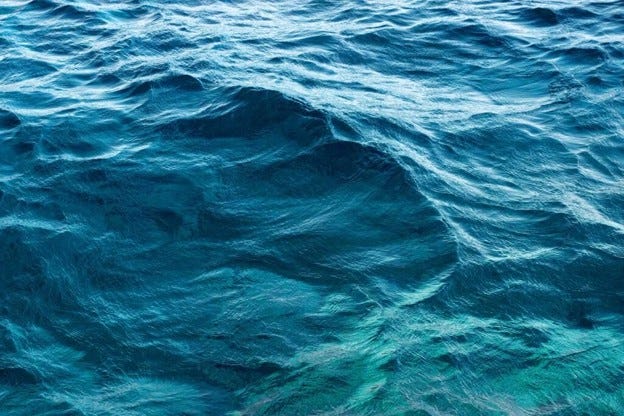
This beauty, this embrace of the deep water, where memory lies. I love Saidiya Hartman’s methodology, which uses fictional narrative to bridge critical theory. Her use of archives to complete those stories seems a uniquely genuine way of bringing what might be lost with what remains. I was watching a tv show about deep ocean creatures - those that live in total darkness and acclimate with bodies that light up, morph genders, and/or live decades. What I didn’t know is that those lowest places hold oxygen either from cold surface water that sinks to the ocean floor or “dark oxygen”, where minerals on the seafloor are slightly magnetic and split the water into hydrogen and oxygen. Something about the richness of this oxygen space feels like a conduit for these odd possibilities. Amiri Baraka’s poem “Wise, Why’s, Y’s: The Griot’s Song Djeli Ya” includes the phrase “At the bottom of the Atlantic Ocean there’s a railroad made of human bones.” But, that idea of momentary freedom for those who jumped from slave ships is counter to this. They do live still, as Jonathan Howard suggests in his book. In areas where there is a large amount of dead matter the life living in that area and consuming the remains consume much of the oxygen while doing so. The railroad of bones then isn’t about death but about structures toward memory, teeming with life and swallowing oxygen same as us. Two choruses: one in the depth and one at the shore.
Do we place our memories in the ocean? Some have always done so as a cultural expression or emotional need. Some realize the potential when they are faced with only being able to see the ocean. Some only see blue and the water as a way to claim the entire world.